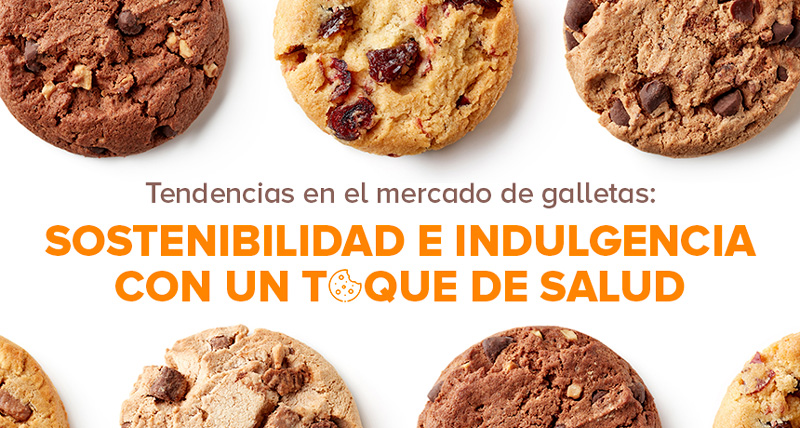
Trends in cookies reflect a consumer who is increasingly concerned about sustainability and health, but who does not want to give up pleasure and indulgence. Brands must go beyond eco-friendly packaging and adopt a more comprehensive approach, covering everything from the origin of ingredients to production processes.
At the same time, there is growing interest in sweet cookies that combine indulgence with a better nutritional profile. In this article, we analyze the main trends in cookies and three opportunities for innovation that can help brands stand out.
Top Trends in Cookies
Brands respond to sustainability concerns
Consumers prefer to pay more for more sustainable cookies
The search for healthier options is another major trend in cookies. With public attention firmly focused on health, consumers hope to balance indulgence with alternatives that offer nutritional benefits.
Not only do they want to see their favorite cookies and crackers packaged in sustainable packaging, but their green expectations are extending to the entire production chain, from sourcing sustainable ingredients to ensuring that farmers are paid fair wages and animals are treated ethically.
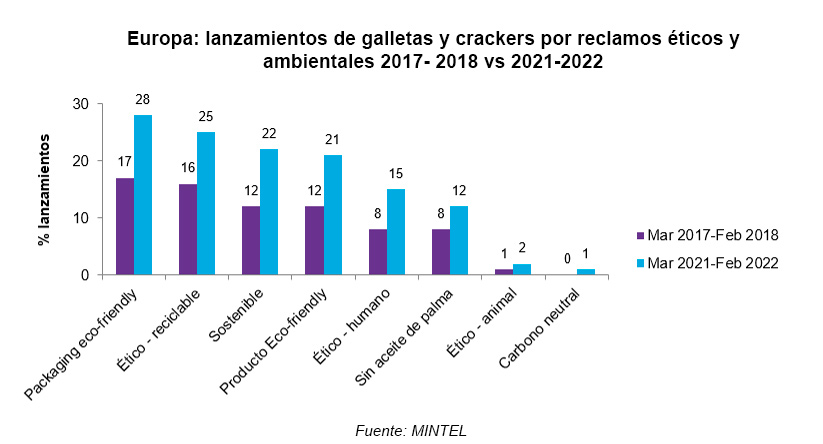
Planetary-friendly claims register an increase
Sustainability claims on new cookie developments in Europe continue to grow. While packaging has attracted most of the sustainable attention, ethical claims have also seen significant growth, specifically around fair trade cocoa for cookies containing chocolate, along with the sourcing of eggs and dairy products from ethical producers.
Cookie brands combine indulgence and health
Consumers seek healthier versions
With public attention firmly focused on health, consumers expect to balance indulgence with healthier options. They also prefer solutions that offer multiple benefits rather than focusing on a specific health issue.
While cookies tend to be associated with indulgent foods, as health awareness grows, brands are innovating around options that balance indulgence with better features. Reducing sugars and fats or highlighting protein and fiber can help elevate the health credentials of cookies.
The "better for you" claims are maintained
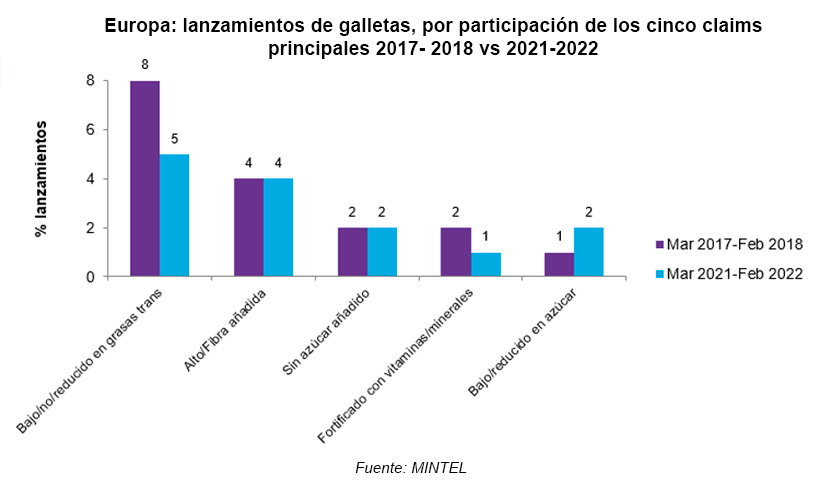
The main "plus" and "minus" claims in the development of new sweet cookies in Europe have remained stable over the past five years, with the exception of a significant drop in low/reduced/trans fat-free claims and slight growth in low/reduced sugar claims.
This is reflected in the average sugar and fat content of cookies over the past five years, which has remained virtually unchanged; in fact, fat content has increased slightly over this period.
Innovation opportunities in the cookie market
After learning about these two trends, experts at Mintel have identified three possible areas of innovation for the sector:
- Using local ingredients to reduce carbon footprint
Cookie brands join forces with farmers and suppliers to adopt sustainable practices that protect the planet. Indicating the provenance of locally grown ingredients adds value by helping to reduce the carbon footprint.
- Breaking the mold of convention
Brands are innovating around traditional products to expand their repertoire and attract consumers who are looking for novelty. A good option is to reinvent classic flavors so that consumers will buy them again, taking advantage of the nostalgia they feel for foods from their childhood.
- Allowing consumers to express themselves through personalization
Covid has moved us away from physical contact by strengthening digital connections and, cookie brands innovate by giving consumers the opportunity to customize products through the internet to offer us the option to design our own cookies.
Once again, health and sustainability are gaining ground, without neglecting the small pleasures that make us feel good.
In short, the trends in cookies show a category that is evolving toward more sustainable, healthy, and distinctive products, without sacrificing indulgence and the pleasure of eating them.
Do you want to keep up to date with the latest trends in the food industry? Sign up for our newsletter.